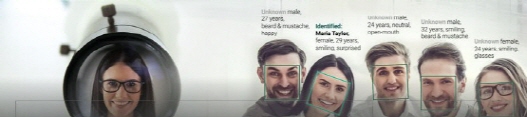
|
About face identification / Face biometrics
| Currently there are many methods of
biometric identification: fingerprint, eye iris, retina, voice, face etc. Each
of these methods has certain advantages and disadvantages which must be
considered in developing biometrical systems, such as: system reliability,
price, flexibility, necessity of physical contact with the scanning device and
many others. Selecting a certain biometrical identification method or using a
multi-biometrical system can help to support these often discrepant
requirements.
|
|

|
Face recognition can be an important
alternative for selecting and developing an optimal biometrical system. Its
advantage is that it does not require physical contact with an image capture
device (camera). A face identification system does not require any advanced
hardware, as it can be used with existing image capture devices (webcams,
security cameras etc.).
Thus, facial recognition should be
considered as a serious alternative in the development of biometrical or
multi-biometrical systems.
Facial recognition technology / Face biometrics
Like fingerprint biometrics, facial
recognition technology is widely used various systems, including physical
access control and computer user accounts security.
Usually these systems extract cetain
features from face images and then perform face matching using these features.
A face does not have as many uniquely measurable features as fingerprints and
eye irises, so facial recognition reliability is slightly lower than these
other biometrical recognition methods. However, it is still suitable for many
applications, especially when taking into account its convenience for user.
Facial recognition can also be used together with fingerprint recognition or
another biometrical method for developing more security-critical applications.
The multi-biometrical approach is
especially important for identification (1:N) systems. In general,
identification systems are very convenient to use because they do not require
any additional security information (smart cards, passwords etc.). However,
using 1:N-matching routines with only one biometrical method, can result in a
higher false acceptance probability, which may become unacceptable for
applications with large databases. Using face identification as an additional
biometric method can dramatically decrease this effect. This multi-biometrical
approach also helps in situations where a certain biometric feature is not
optimal for certain groups of users. For example, people who do heavy labor
with their hands may have rough fingerprints, which can increase the false
rejection rate if fingerprint identification was used alone.
Related Products / Face biometrics
VeriLook SDK
The VeriLook technology is
intended for facial recognition system integrators. VeriLook offers fast
reliable identification with live face detection and the ability of multiple
face processing in a single frame.
VeriLook 3.2 SDK is camera independent,
webcam capable and offers a set of programming samples and tutorials written in
major programming languages. These types of SDK are available: • VeriLook 3.2 Standard SDK is intended for
PC-based biometrical application development. It includes Matcher and Extractor
components, programming samples and tutorials, camera manager software and
software documentation. The SDK allows the development of biometric
applications for Microsoft Windows, Linux or Mac OS X operating systems. • VeriLook 3.2 Extended SDK is intended for
biometrical Web-based and network application development. It includes all
features of Standard SDK. Additionally, the SDK contains sample client
applications, tutorials and a ready-to-use matching server.
FaceCell EDK
The FaceCell technology has been
developed for using in various embedded or mobile hardware, like smart phones,
handheld computers and devices.
FaceCell 1.1 EDK is available on 30
day trial period. This downloadable
trial kit allows developers to explore the technology and to try it in real
environments and real applications.
MegaMatcher SDK
MegaMatcher
is a multi-biometrical technology, intended for large-scale face-fingerprint
systems and AFIS integrators. The technology includes fingerprint and facial
recognition engines that could be used either separately or together. The face
engine shows an outstanding matching speed, which makes it especially valuable
for large-scale systems.
MegaMatcher
2.0 SDK includes server software for local multi-biometrical systems, cluster
software for large-scale multi-biometrical products development, and a set of
valuable task-specific components.
Overview / PC-based face recognition summary
Facial identification software becomes more
and more popular in various applications and systems, including PC logon, employee
access and attendance control, customer management systems. This kind of
biomerical identification offers convenience for end-users together with decent
identification reliability and speed of identification.
A face identification system can be designed
using: 1. a common PC, that offers enough
capabilities to perform fast facial recognition and matching, 2. a camera or webcam, that can be obtained
for an affordable price, 3. software, which can be rapidly developed
using a face identification SDK with all necessary technologies, algorithms and
interfaces included.
Once the software is developed, the system
can be scaled up by adding more PCs, cameras and obtaining additional
technology licenses.
Neurotechnology offers face identification
technology and SDKs that offer the needed performance and reliability for a
reasonable price.
The technology / PC-based face recognition summary
VeriLook technology
assures system performance with fast matching (up to 100,000 faces per second) and
reliable face recognition. The technology contains these proprietary
algorithmic solutions: • live face detection for determining whether
a face in a video stream belongs to a real human or is a photo; • multiple face localization in live video
streams and still images; • simultaneous multiple face processing and
identification in single frame; • identification (1:N) ability; • features generalization for even more
reliable identification; • compact template (2.3 Kbytes) that allows
to handle large databases.
Algorithm demo application is available for
downloading. Read more about the
technology.
The SDK / PC-based face recognition summary
VeriLook SDK is based on the VeriLook
facial recognition technology and is intended for biometric systems developers
and integrators. It allows easy integration and rapid development of biometric
applications using functionality from the VeriLook algorithm, which ensures
high reliability of the face identification, 1:1 and 1:N matching modes and comparison
speeds of up to 100,000 faces per second. The integrator has complete control
over SDK data input and output.
VeriLook SDK supports Microsoft Windows,
Linux and Mac OS X. The following types of SDK are available: • VeriLook 3.2 Standard SDK is intended for
PC-based biometrical application development. It includes Matcher and Extractor
components, programming samples and tutorials, camera manager software and
software documentation. The SDK allows the development of biometric
applications for Microsoft Windows, Linux or Mac OS X operating systems. • VeriLook 3.2 Extended SDK is intended for rapid
development of biometrical Web-based and network applications. It includes all
features of Standard SDK. Additionally, the SDK contains sample client
applications, tutorials and a ready-to-use matching server.
Why VeriLook? / VeriLook Face Recognition Technology
Neurotechnology has developed a PC-based
face recognition algorithm VeriLook 3.2 designed for biometrical system
integrators. VeriLook 3.2 offers capabilities of advanced and convenient facial
identification systems at a reasonable cost: • Reliability. The
VeriLook 3.2 algorithm has been tested with standard face databases (FERET,
XM2VTSDB and others). The results are one of the best among existing face
identification systems on the market. • Speed. VeriLook
3.2 face enrollment time is less than 0.3 sec. and matching speed is 100,000
faces per second in 1:N identification mode. To confirm these results with your
samples, please try VeriLook algorithm demo application. • Live face detection. A conventional face
identification system can be easily cheated by placing a photo of another
person in front of a camera. VeriLook is able to prevent this kind of security
breach by determining whether a face in a video stream belongs to a real human
or is a photo. • Multiple face processing. VeriLook 3.2
detects all faces in the current frame and can process all of them
simultaneously. • VeriLook doesn't
require any specific hardware. The face image can be obtained from a webcam or
other low cost camera. Image processing and recognition are performed on an
ordinary PC.
| • Biometrical template record can contain multiple
face samples belonging to the same person. These samples can be enrolled with
different face postures and expressions, from different sources and in
different time thus allowing to improve matching quality. For example a person
could be enrolled with and without eyeglasses or with different eyeglasses,
with and without beard or moustache, smiling and non-smiling etc. • Both face and
fingerprint recognition technologies from the same vendor. Compatible product
interfaces and customer support from the same source allow simple multi-biometric
system integration and help to achieve high system recognition quality. The
VeriLook algorithm can be used alone or together with other Neurotechnology's
biometrical algorithms. • VeriLook is designed not only for verification, but also for identification
(1:N matching).
|
|
Multiple Face Detection
 Click to zoom
|
Algorithm / VeriLook Face Recognition Technology
The VeriLook 3.2 face recognition algorithm
implements advanced face localization, enrollment and matching using robust
digital image processing algorithms: • Fast and accurate
face localization for reliable detection of multiple faces in live video
streams and still images. • Simultaneous
multiple face processing and identification in single frame. All faces on the
current frame are detected in 0.07 sec.* and then each face is processed in 0.13
sec.*. • Face quality threshold can be used during
face enrollment to ensure that only the best quality face template will be
stored into database. • The VeriLook 3.2
face template matching algorithm compares 100,000 faces per second*. • Applications
implemented using VeriLook SDK can handle large face databases, as one face
features template is only 2.3 Kbytes. • Features
generalization mode generates the collection of the generalized face features
from several images of the same subject. Then, each face image is processed,
features are extracted, and the collections of features are analyzed and
combined into a single generalized features collection, which is written to the
database. This way, the enrolled feature template is more reliable and the face
recognition quality increases considerably. • VeriLook has certain tolerance to face
posture that assures face enrollment convenience: rotation of a head can be up
to 10 degrees from frontal in each direction (nodded up/down, rotated
left/right, tilted left/right). • Biometrical template record can contain several
face samples belonging to the same person. These samples can be enrolled from
different sources and in different time thus allowing to improve matching
quality. For example a person could be enrolled with and without eyeglasses or
with different eyeglasses, with and without beard or moustache, etc.
* All performance evaluations were
performed using a PC with 2.8 GHz Intel Pentium4 CPU
Reliability Tests and Technical Specifications / VeriLook Face Recognition Technology
|
 Click to zoom
|
VeriLook 3.2 was tested with face images
from many cameras. The most interesting testing results are those obtained with
standard databases, because in this case they can be compared with testing
results of other algorithms. Usually the algorithm recognition quality is
expressed by receiver operating curves (ROC), which show the dependence of
false rejection rate on the false acceptance rate. The presented ROC shows the results
of testing VeriLook 3.2 with face images from XM2VTSDB database. The red curve
shows the performance results of VeriLook 3.2 without generalization, and the
green one shows the results of VeriLook 3.2 with generalization.
|
|
VeriLook 3.2 algorithm technical specifications
|
|
Recommended minimal image size
|
640 x 480 pixels
|
|
Multiple faces detection time (using 640 x 480 image)
|
0.07 sec.
|
|
Single face processing time (after detecting all faces)
|
0.13 sec.
|
|
Matching speed
|
100,000 faces/sec.
|
|
Size of one record in the database
|
2.3 Kbytes
|
|
Maximum database size
|
unlimited
|
All performance evaluations were performed
using a PC with 2.8 GHz Intel Pentium4 CPU
Algorithm's Demo / VeriLook Face Recognition Technology
|
 Click to zoom
|
|
The VeriLook demo application for Microsoft
Windows 2000/XP/2003/Vista can be downloaded for
evaluation of the VeriLook face recognition algorithm. The application enrolls
and identifies faces from almost any camera or webcam, and image files.
Internet connection is not required to run the application.
VeriLook 3.2 Standard SDK and Extended SDK
trials are also available for downloading.
|
Related Products / VeriLook Face Recognition Technology
These products are based on the VeriLook
technology: • VeriLook 3.2
Standard SDK; • VeriLook 3.2
Extended SDK.
Overview / VeriLook Face Identification SDK
VeriLook SDK is based on the VeriLook PC-based face
recognition technology and is intended for biometric systems developers and
integrators. It allows rapid development of biometric applications using
functions from the VeriLook library, which ensure high reliability of the face
identification. VeriLook SDK enables1:1 and 1:N matching modes, simultaneous multiple face detection,
processing and identification with a comparison speed of 100,000 faces per
second.
VeriLook can be easily integrated into the
customer's security system. The integrator has complete control over SDK data
input and output.
VeriLook SDK includes Camera Manager
library for Microsoft Windows which allows to perform simultaneous capture from
multiple cameras.
Contents of VeriLook 3.2 Standard SDK and Extended SDK / VeriLook Face Identification SDK
VeriLook is available as the following
SDKs: • VeriLook 3.2 Standard SDK is intended for
PC-based biometrical application development. It includes Matcher and Extractor
components, programming samples and tutorials, camera manager library and
software documentation. The SDK allows the development of biometric
applications for Microsoft Windows, Linux or Mac OS X operating systems. • VeriLook 3.2 Extended SDK is intended for
biometrical Web-based and network application development. It includes all
features of Standard SDK. Additionally, the SDK contains sample client
applications, tutorials and a ready-to-use matching server.
The table below compares VeriLook 3.2
Standard SDK and VeriLook 3.2 Extended SDK.
|
|
VeriLook Standard SDK
|
VeriLook Extended SDK
|
|
Components
|
MS Windows (32 & 64 bit)
|
Linux (32 & 64 bit)
|
Mac OS X
|
MS Windows (32 & 64 bit)
|
Linux (32 & 64 bit)
|
Mac OS X
|
|
• VeriLook 3.2 Extractor
|
1 license
|
3 licenses
|
|
• VeriLook 3.2 Matcher
|
1 license
|
1 license
|
|
• Camera manager library
|
+
|
|
|
+
|
|
|
|
VeriLook Matching Server
|
|
• Matching server software
|
|
|
|
+
|
+
|
|
|
• Server administration tool API
|
|
|
|
+
|
+
|
|
|
• Microsoft SQL Server support module
|
|
|
|
+
|
|
|
|
• MySQL database support module
|
|
|
|
+
|
+
|
|
|
• Oracel database support module
|
|
|
|
+
|
+
|
|
|
• SQLite database support module
|
|
|
|
+
|
+
|
|
|
Programming samples
|
|
• C/C++
|
+
|
+
|
+
|
+
|
+
|
+
|
|
• C#
|
+
|
|
|
+
|
|
|
|
• C# web client (for Matching Server)
|
|
|
|
+
|
|
|
|
• Sun Java 2
|
+
|
+
|
|
+
|
+
|
|
|
• Sun Java 2 web client (for matching server)
|
|
|
|
+
|
+
|
|
|
• Visual Basic 6
|
+
|
|
|
+
|
|
|
|
• Visual Basic .NET
|
+
|
|
|
+
|
|
|
|
• VBA (Microsft Access 2003)
|
+
|
|
|
+
|
|
|
|
• Delphi 7
|
+
|
|
|
+
|
|
|
|
Programming tutorials
|
|
• C
|
+
|
+
|
+
|
+
|
+
|
+
|
|
• C/C++ (for Matching Server)
|
|
|
|
+
|
+
|
|
|
• C#
|
+
|
|
|
+
|
|
|
|
• C# (for Matching Server)
|
|
|
|
+
|
|
|
|
• Visual Basic 6
|
+
|
|
|
+
|
|
|
|
• Visual Basic .NET
|
+
|
|
|
+
|
|
|
|
• Delphi 7
|
+
|
|
|
+
|
|
|
|
Documentation
|
|
• VeriLook 3.2 SDK documentation
|
+
|
VeriLook Matching Server / VeriLook Face Identification SDK
VeriLook Matching Server software is not
included in VeriLook 3.2 Standard SDK.
VeriLook Matching Server is a ready-to-use
software that performs the identification and verification of fingerprints on
the server side. The server is intended to be used in web-based and other
network-based systems.
VeriLook Matching Server runs on PCs with
Microsoft Windows or Linux and includes these additional components: • Server administration tool for monitoring
servers state, managing log and other server administration tasks; • Support modules for MySQL and Oracle
databases. • Sample client applications: ° C# sample (for Microsoft Windows); ° C sample (for Linux); ° Sample Java applet.
VeriLook Extractor component / VeriLook Face Identification SDK
VeriLook Extractor creates face templates
from face images. Image quality control can be applied to accept only good
quality face images.
The Extractor can generalize a face
template from several face images to improve template's quality.
Live face detection can be used for
determining whether a face in a video stream belongs to a real human or is a
photo.
VeriLook Matcher component / VeriLook Face Identification SDK
VeriLook Matcher performs face template
matching in1:1
and 1:n modes.
Camera Manager library / VeriLook Face Identification SDK
Camera Manager library works under
Microsoft Windows and provides functionality for working with cameras. The
library allows to perform simultaneous capture from multiple cameras.
System requirements / VeriLook Face Identification SDK
System requirements for VeriLook Mathing
Server • PC with x86 compatible CPU (2 GHz processor
or better is recommended); • UDP and TCP network support; • MySQL or Oracle server (other DB servers
require a custom support module to be developed by the integrator); • Microsoft Windows specific: ° Microsoft Windows 2000/XP/2003/Vista. • Linux specific: ° Linux 2.6 or newer; ° GCC-4.0.x or newer; ° pkg-config-0.21 or newer; ° GNU Make 3.81 or newer; ° GTK+-2.10.x or newer libs and dev packages; °
libtiff-3.8.x or newer libs and dev
packages;
System requirements for VeriLook Matcher
and Extractor components: • PC or Mac with 2 GHz processor or better; • Optionally, camera or webcam (recommended
frame size: 640 x 480); • Microsoft Windows specific: ° Microsoft Windows 2000/XP/2003/Vista ° Microsoft DirectX 8.1 or later ° Microsoft XML Parser (MSXML) 3.0 ° Microsoft GDI+ library • Linux specific: ° Linux (based on glibc 2.5 or newer) ° Video4linux • Mac OS X specific ° Mac OS X (version10.3.9 or newer) ° QuickTime 6 or later
SDK Trials / VeriLook Face Identification SDK
Neurotechnology offers VeriLook 3.2
Standard SDK and Extended SDK on a 30 day trial. The trials allows developers
to explore the SDKs' possibilities and to try them in real environments and
real applications. Constant Internet connection is required during evaluation.
VeriLook SDK trials are available for downloading.
The VeriLook 3.2 algorithm demo application
for Microsoft Windows is also available for downloading.
Licensing VeriLook
To develop a product based on VeriLook 3.2
technology, an integrator should obtain VeriLook 3.2 Standard SDK (EUR 339) or
VeriLook 3.2 Extended SDK (EUR 859). Integrators can develop only an end-user
product using VeriLook SDK and sell/install the product to their own customers.
If an integrator wants to develop and sell
a VeriLook based development tool (with custom API, programming possibilities,
samples, etc.), he/she will need to become a value-added reseller (VAR). More
information is available in VAR licensing
model.
VeriLook 3.2 components are: • VeriLook 3.2 Matcher • VeriLook 3.2 Extractor
A license is required for each running
instance of VeriLook components. The following license types are available: • Single
computer license. • Concurrent
network license. • Enterprise
license.
VeriLook 3.2 Standard SDK includes: • 1 VeriLook Matcher license. • 1 VeriLook Extractor license.
VeriLook 3.2 Extended SDK includes: • 1 VeriLook Matcher license. • 3 VeriLook Extractor license.
VeriLook 3.2 SDK customers can obtain
additional VeriLook 3.2 components licenses for their product installation or
development at any time. Prices for additional VeriLook 3.2 component licenses
can be found here.
Please also refer to VeriLook 3.2 SDK
Software License Agreement for all licensing terms and conditions.
Single computer license
A single computer license allows to install
and run a VeriLook 3.2 component installation on one computer. Component
license will not be lost if computer will be reinstalled.
The following license management options
are available: • license activation online by communicating
with Neurotechnology's server; • license activation by email; • license activation using volume
license manager; • license management using volume
license manager on LAN or Internet.
Concurrent network licenses
VeriLook Extractor concurrent license
allows to install VeriLook Extractor component on an unlimited number of
computers. Volume
license manager is used to manage these licenses across the computers on
LAN or Internet. The allowed number of simultaneously running VeriLook
Extractor component instances is limited by the number of obtained concurrent
licenses which are stored in the license manager.
This type of licensing is especially useful
for web-based software.
VeriLook 3.2 enterprise license
VeriLook enterprise license allows an unlimited
use of VeriLook components (Extractor and Matcher) in the end-user products in
the certain territory, market segment or project. These limitations would be
included in the licensing agreement.
The enterprise license price depends on the
application size and the number of potential application's users within the
designated territory, market segment or project. VeriLook enterprise licenses
are provided only for big projects, with price range starting at EUR 20,000.
VeriLook algorithm source code may be
included with a special source code licensing agreement for the selected
customers, who are going to obtain VeriLook enterprise license for at least EUR
100,000 or more.
For more information please contact us.
Volume license manager
Volume license manager is used on site by
integrators or end users to manage obtained licenses for VeriLook 3.2
components. It consists of license management software and a dongle, which are
used to store the number of obtained licenses. An integrator or an end-user can
use the volume license manager in the following ways: • Activating the single computer licenses. An
installation license for a VeriLook 3.2 component will be activated for using
on a particular computer. The license quantity for the VeriLook component in
the license manager will be decreased by the amount of activated licenses. • Managing the single computer licenses on
LAN or Internet. The license manager allows to manage installation licenses for
VeriLook components across the computers on LAN or Internet. The number of
managed licenses for a VeriLook component is limited by the number of licenses
in the license manager. No license activation is needed and the license
quantity is not decreased. Once issued, the license is assigned to certain
computer on the network. • Using a license manager as a dongle. The
volume license manager containing at least one license for a VeriLook 3.2
component can be used as a dongle that allows to run VeriLook 3.2 component
installation on a particular computer.
Additional VeriLook 3.2 component
installation licenses for the license manager can be purchased anytime.
Neurotechnology will generate a special update file and send it to you. Then
you will just have to enter the file to the license manager to add these
purchased licenses.
Existing VeriLook 3.0/3.1 customers may
also use license management options listed in this reference.
Existing VeriLook 2.0 customers may also
use license management options listed in this reference.
* If the integrator wants to develop and
sell a VeriLook based development tool (with API, programming possibilities,
programming samples, etc.), he/she will need a permission from Neurotechnology
and shall sign a special VAR agreement. |